

Radical Subjectivity: Katalin Ladik and Tomaso Binga
3.7.–27.9.2026.
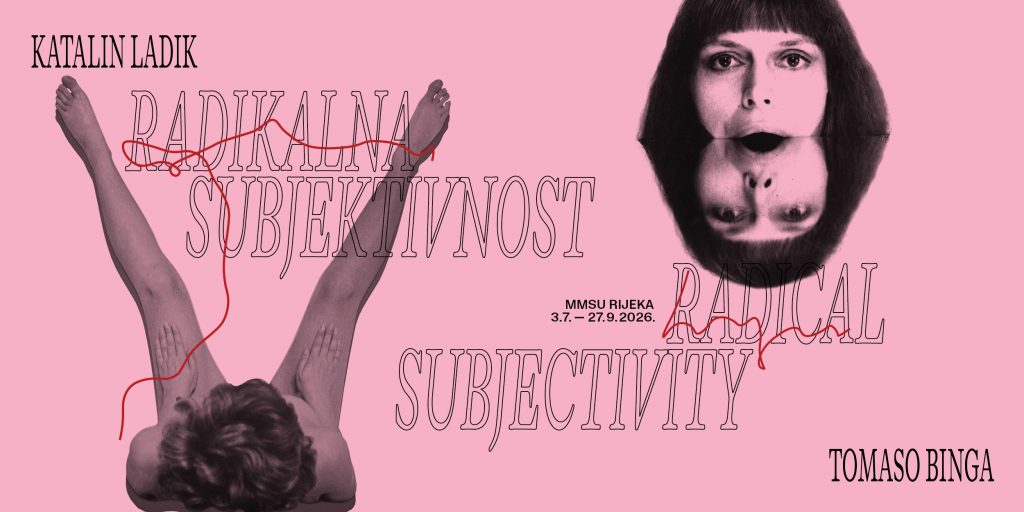
Radical Subjectivity brings together a selection of seminal works by Katalin Ladik and Tomaso Binga, among the most influential European artists working in experimental visual poetry at the intersection of language and image. The exhibition opens on Friday, 3 July, at 8:00 PM.
Radical Subjectivity, a large-scale double solo exhibition by Katalin Ladik and Tomaso Binga at the Museum of Modern and Contemporary Art in Rijeka brings together works by two leading artists who, since the 1960s and 1970s, have developed experimental practices focused on the relationship between language, the body, and voice. Hungarian artist Katalin Ladik, born in Novi Sad, and Italian artist Tomaso Binga (born Bianca Pucciarelli Menna) are among the most significant figures in European visual poetry and performance art. Through a radical examination of the boundaries of language, voice, and corporeality, their practices address questions of identity, gender, and subjectivity, while also shaping spaces of resistance to dominant cultural, social, and gender norms.
Alongside their shared interest in visual poetry and the limits and potentials of language, the artistic practices of Katalin Ladik and Tomaso Binga are linked by their exploration of identity and the performance of gender. Through collage, photography, performance, and video, both artists transform language, voice, the body, and the image into tools for articulating identities and gender positions.
While Katalin Ladik, in her performative photographic series based on self-representation such as Poemim (1978) and Androgyn (1978), destabilises conventional representations of female identity and questions the fluidity of gender roles, Tomaso Binga incorporates gender performativity into the very act of constructing her artistic identity, adopting a male pseudonym as a strategy for entering the art system. Ladik’s collages, made using dressmaking pattern sheets from women’s magazines, further address questions of women’s craft and material culture. In both cases, what is at stake is the subversion of identity, as well as an ironic re-examination of social expectations and traditional gender norms.
In the work of Tomaso Binga, the body becomes a script – from figures that form letters of the alphabet to de-semanticised handwriting that loses its communicative function and becomes a visual structure. In Ladik’s works, the body and voice render the boundaries of language permeable, transforming words into rhythm, breath, and sound.
Today, when questions of freedom of expression, the body, and identity are contested within broader social contexts, the works of Katalin Ladik and Tomaso Binga—although produced within specific historical and artistic circumstances—appear as contemporary echoes that transcend purely historical readings. They remind us that historical artistic and social processes can be understood as structures of the present that continue to shape contemporary social and artistic imagination
The exhibition features a selection of seminal works situated at the intersection of the verbal and the visual, presenting language as a space of play and resistance. Through various strategies of reconfiguring language, the body, and text, the works explore the production of radical subjectivity.
Most of the works are being exhibited in Croatia for the first time, including a newly discovered photographic documentation of Katalin Ladik’s performance in Rijeka in 1970, captured by local photographer Ranko Smokvina.
Curated by: Branka Benčić.
Opening: 3/7 at 20 h
The exhibition is funded by the City of Rijeka, Ministry of Culture and Media Republic of Croatia, and Primorje–Gorski Kotar County. It is made possible with works on loan from acb gallery, Galleria Tiziana di Caro, and Frittelli Arte Contemporanea. Acknowledgements: Archivio Tomaso Binga, Fondazione Filiberto e Bianca Menna, Ranko Smokvina. Additional support: Liszt Institute – Hungarian Cultural Centre Zagreb and Wiener Insurance.